
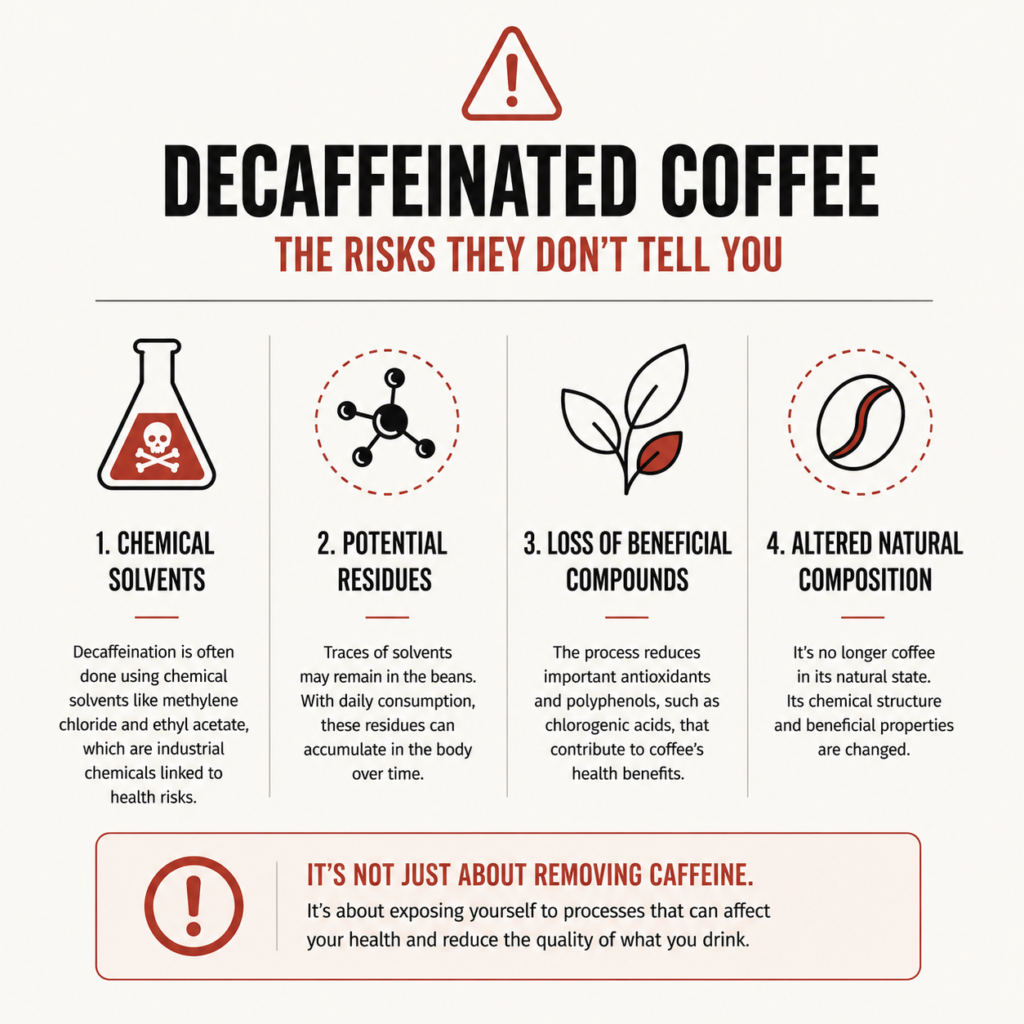
Decaffeinated coffee is often marketed as the “healthier” option for people trying to avoid caffeine.
But from a scientific and toxicological perspective, the real question is not whether caffeine was removed…
👉 it’s how it was removed.
🧪 Decaf Coffee Is Not Naturally Decaffeinated
Coffee beans naturally contain caffeine.
To remove it, manufacturers must subject the beans to industrial extraction processes before roasting.
Some of the most commonly used methods involve chemical solvents such as:
- Methylene chloride (dichloromethane)
- Ethyl acetate
These are not naturally occurring food compounds.
They are industrial solvents used in various chemical applications.
⚠️ Methylene Chloride: Why It Raises Concerns
Methylene chloride has been evaluated by organizations such as the Environmental Protection Agency and the World Health Organization.
Scientific literature has associated high exposure levels with:
- Central nervous system effects
- Headaches and dizziness
- Cognitive impairment
- Potential carcinogenicity in long-term exposure settings
Although regulatory agencies allow very small residual levels in food products, an important distinction remains:
👉 “Legally permitted” does not necessarily mean “biologically optimal.”
Especially when discussing:
- Daily consumption
- Long-term cumulative exposure
- Repeated intake over years
🧬 Decaffeination Alters More Than Just Caffeine
One of the strongest scientific concerns is that decaffeination is not perfectly selective.
Research published in journals such as Journal of Agricultural and Food Chemistry has shown that decaffeination processes can reduce:
- Chlorogenic acids
- Polyphenols
- Antioxidant capacity
A PubMed-indexed study by Farah et al. (2006) demonstrated significant reductions in chlorogenic acids during decaffeination.
These compounds matter because they are among the primary bioactive antioxidants naturally present in coffee.
👉 In other words, decaf coffee is not simply “coffee without caffeine.”
It is chemically and structurally altered coffee.
🧪 Residual Solvents: The Debate Isn’t Completely Closed
During roasting, much of the solvent evaporates.
However:
- Trace residues may still remain
- Toxicology experts continue debating long-term cumulative exposure effects
Recent scientific discussions continue acknowledging uncertainty regarding chronic exposure implications.
The issue is not immediate poisoning.
The issue is whether repeated exposure to chemically processed products is truly ideal for long-term health optimization.
🌊 What About “Chemical-Free” Decaf?
Some brands use methods like Swiss Water Process, which avoid synthetic solvents.
While this is considered a cleaner alternative, it still:
- Removes additional soluble compounds alongside caffeine
- Alters the bean’s original chemical profile
- Reduces some antioxidant content
So even solvent-free decaf is not metabolically identical to regular coffee.
🧠 A Toxicology Principle Most People Ignore
In toxicology, one of the most important concepts is:
👉 cumulative exposure matters.
Even very small exposures, repeated daily over years, deserve scientific scrutiny — especially when they involve industrial processing compounds.
This is why many researchers and health-conscious consumers question whether decaf coffee truly represents the “healthier” option it is often marketed to be.
⚖️ Evidence-Based Conclusion
Scientific literature does not claim that decaf coffee is “poison.”
However, the evidence clearly shows that decaffeinated coffee:
- Undergoes intensive industrial processing
- May involve solvent exposure
- Loses important bioactive compounds
- Experiences structural chemical alterations
And while it may comply with regulatory standards…
👉 that does not automatically make it the optimal choice for long-term daily consumption.
🎯 Final Thought
“Decaffeinated coffee is not simply coffee without caffeine…
it is coffee that has been chemically altered to remove one of its natural components — often at the cost of changing much more.”